


Tom Whitfield, Features Reporter.
Check the mirror at midday and the volume you built at eight o’clock has usually gone. Lashes look flattened, a little clumped at the outer corner, maybe a smudge low on the lid. The bathroom drawer probably holds three or four half-used tubes, each bought after the last one disappointed, each promising fibre technology or a multiplied lash count on the box.
The honest answer is rarely the formula itself. It is almost always how the mascara was chosen, applied or stored. The polymer film that gives lashes their held shape starts breaking down within hours of contact with the natural oils on the lid, and the wrong technique speeds that up considerably. This guide works through the specific habits that shorten volume and the small adjustments that keep it, without buying anything new.
- Application order matters more than the formula does: curling lashes before mascara, never after, prevents the single most common cause of flattening and breakage.
- One thin coat, built up slowly, outlasts three thick ones: clumping and premature fade usually come from too much product applied too fast, not from a weak formula.
- Most volume loss is a storage problem: pumping the wand in and out of the tube pushes air in and dries the formula out within weeks of opening.
Why Lashes Look Thin By Lunchtime

Volumising mascara works by coating each lash in a polymer film, sometimes with tiny fibres suspended in it, that thickens the shaft and holds a curled shape. The film is designed to dry quickly once it meets air, which is why a second coat applied too late drags rather than layers.
The trouble starts almost immediately. Sebum, the natural oil produced along the lash line, begins to soften that polymer film within a few hours. Add blinking, which flexes each lash roughly fifteen thousand times a day, and the held curl relaxes under its own weight by early afternoon.
It behaves rather like a stiffly set hairstyle on a damp day: the shape was real, but it needed conditions it did not get. There is no fixing this with a thicker formula. The fix is technique and timing, covered below.
Matching The Wand To Your Lash Type Before Anything Else
Most volume disappointment starts at the counter, not the bathroom. An hourglass-shaped wand, narrow in the middle and fuller at the tips and root, is built for lashes that are already reasonably dense and need shaping at the corners. A tightly packed, straight brush loads more product per stroke and suits sparse or fine lashes that need bulk rather than definition.
The mistake is choosing by the claim on the box rather than by the brush in hand. “12x volume” describes a marketing test, not your lash pattern.
At a chemist counter, most testers are still out for exactly this reason. Run a finger along the bristles: wide gaps mean it will deposit fibres unevenly on fine lashes; tight, dense bristles mean it may sit heavy on lashes that are already thick. Superdrug and Boots counters generally keep testers open for this reason, and five minutes with one is more useful than any packaging copy.
How Many Coats Is Actually Too Many
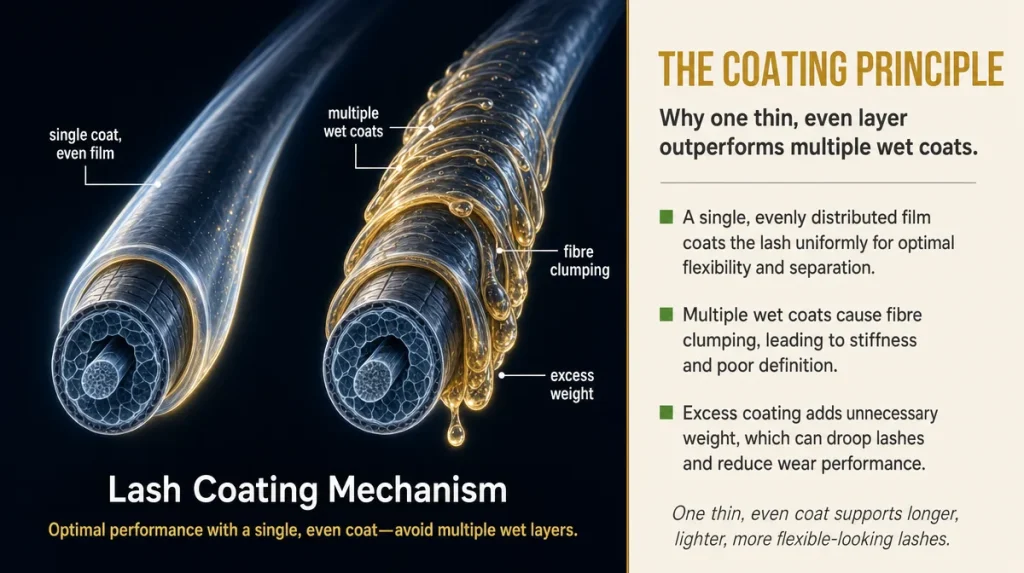
A single coat adds pigment and a thin polymer layer. A second coat, applied while the first is still tacky, does not add clean volume: it drags the wet layer, clumps the fibres together, and often transfers to the lid.
Think of it as adding a second coat of paint before the first has properly dried. The surface goes lumpy rather than richer.
The workable method is one thin coat from root to tip, a wait of roughly thirty seconds, then a second light pass only at the roots, where volume reads most convincingly. A 2023 study in the Journal of Cosmetic Science, testing repeated-application patterns on false lash strips, found that clump formation rose sharply after the second coat regardless of formula viscosity. Beyond two coats, most of what is being added is weight, not visible fullness.
The Curling Order Most People Get Backwards
Lashes should be curled before mascara goes on, never after. This sounds like a small detail but it accounts for a disproportionate amount of lash breakage reported anecdotally by opticians and dermatologists alike.
Once mascara is applied, the polymer film is technically wet and slightly tacky even when it looks dry. Clamping a heated or mechanical curler onto coated lashes can pull strands out at the follicle, and the curler pad picks up product, which then transfers unevenly next time it is used.
The order that works: curl clean, dry lashes first, hold for ten seconds, then apply mascara from root to tip while the curl is fresh. If a second lift is needed later in the day, a cotton bud can gently reshape the tips without touching a heated tool to product-coated lashes at all.
Storage Habits That Quietly Dry Out Volume
Mascara has a shorter working life than almost anything else in a make-up bag, generally three months once opened, and the wand itself is usually to blame.
Every time the wand is pumped in and out of the tube to load more product, it pushes a small amount of air in with it. Air oxidises the formula and evaporates its liquid content, so a tube that looked fine in January can turn dry and clumpy by March even if it is barely half used.
The better habit is to twist the wand gently while withdrawing it, rather than pumping, and to keep the tube capped tightly between uses rather than left open on a shelf near a radiator. Cosmetics chemists commonly cite central heating as a factor here too: British homes run drier air through fixed radiators for months at a time, which speeds up the same drying process that damp winters otherwise slow down on skin.
Removing Volumising Formulas Without Pulling Lashes Out With Them
Fibre and polymer formulas are built to resist water, which means plain cleanser and cotton wool tend to rub rather than dissolve the film. Rubbing is what pulls lashes out along with the product, not the mascara itself.
An oil-based remover, or a micellar water formulated for eyes, breaks the polymer bond chemically rather than mechanically. Press a soaked pad against closed lashes for a slow ten count before wiping, rather than scrubbing immediately.
The Good Housekeeping Institute’s general guidance on eye make-up removal makes the same point in its household testing notes: patience with a dissolving product outperforms pressure with a dry one, for lashes as much as for skin.
What “Volumising” Means On The Ingredients List Versus On The Box
The words that actually do the volumising work are usually buried in the ingredients list, not the front-of-pack claim. Look for waxes such as carnauba or beeswax, which build bulk; film-forming polymers, which hold shape; and, in fibre formulas, short strands of nylon or rayon that physically extend and thicken the lash.
“Buildable” on a label simply means the formula is designed to be layered without clumping too quickly, which is a genuine and useful trait. “Volumising” on its own is not a regulated term and describes intent rather than a measured result.
Which? magazine’s comparative testing has repeatedly noted that packaging claims correlate poorly with actual lash-thickening performance across price points, which is a useful reminder that the ingredients list, not the front label, is where the real information sits.
A Two-minute Self-test For The Mascara Already In Your Bag
Before buying anything new, it is worth testing what is already at home. Apply one coat to dry, clean lashes and check three things over the next six hours.
Does it flake onto the cheek by mid-afternoon? That usually points to a formula that has dried out or oxidised, more often a storage issue than a bad product. Does it clump at the outer corner specifically? That is frequently a wand mismatch rather than a formula fault. Does the curl relax within an hour regardless of technique? That suggests the polymer film itself is simply too soft for the lash type.
Running this small test before discarding a tube saves money and identifies which of the habits above is actually the one worth changing first.
Key Takeaways
Volume loss during the day is rarely about buying a stronger formula. Curl before applying, never after. Build one thin coat rather than several thick ones, waiting for each to set. Twist the wand out rather than pumping it, and replace mascara roughly every three months once opened. Remove with an oil-based product and patience rather than pressure, and check the ingredients list, not the front-of-pack claim, when judging what a formula can realistically do.
A Quick Checklist Before Your Next Application
- Curl lashes first, on completely dry lashes, before any product goes on
- Apply one thin coat root to tip, wait thirty seconds, then a light second pass at the roots only
- Twist the wand while withdrawing it rather than pumping it in and out of the tube
- Keep the tube capped and away from radiators or direct heat
- Replace the tube around the three-month mark after opening, sooner if it starts to drag or flake
- Remove with an oil-based or micellar formula, pressed and held rather than rubbed
This article is general information and does not replace advice from a dermatologist, optician or make-up professional.
Individual results with any technique or product may vary.