

Ellie Marsden, Beauty Editor.
There is a particular moment at the Boots fragrance counter when the tester strips start to blur into one smell. You have sprayed four, maybe five, and your nose has quietly given up on you. You buy the one whose bottle looks nicest, or the one the assistant seemed most enthusiastic about, and three months later it sits half-used on the shelf with the others, smelling faintly of nothing you remember choosing.
The truth is that judging a perfume well has almost nothing to do with your sense of smell holding out under pressure. It is a skill with a method, and most people never learn it because nobody ever explains what actually happens between the moment scent leaves the bottle and the moment it fades on your wrist eight hours later. One useful fact to start with: a fragrance changes composition for as long as it is on your skin, which is precisely why the first impression at the counter is the least reliable one you will get.
This guide sets out what actually separates a fragrance that will still please you in a year from one that will end up unworn, using the same logic that trained noses and product assessors use, translated into something you can do standing at a counter or sitting at your dressing table.
- Judge a fragrance in stages, not in one sniff: the top notes you smell in the first ten minutes are not the perfume you will be wearing by lunchtime.
- Concentration labels tell you staying power, not quality: an eau de parfum and an eau de toilette from the same range can smell identical for the first hour.
- Skin chemistry changes the fragrance more than the bottle admits: testing on paper first, then on skin, tells you which effect you are actually reacting to.
Why The First Spray Lies To You

Perfume is built in layers, and the layer you smell in the first few minutes is designed to sell the bottle, not to last the day. Perfumers call these top notes, and they are chosen for lightness and immediacy: citruses, light florals, aldehydes. They are the loudest ingredients and the first to evaporate, often within fifteen to twenty minutes.
Think of a fragrance like a three-course meal served all at once on the same plate. The starter reaches your nose first simply because it is closest to the surface, not because it is the most important part of the meal. The main course, the heart notes, and the digestif, the base notes, are still coming.
A 2019 study in the International Journal of Cosmetic Science tracked how perceived fragrance character shifted over a six-hour wear period on 40 female participants, and found that consumer preference ratings given in the first five minutes correlated poorly with ratings given after two hours. In practical terms, this means the spray that smells wonderful on the back of your hand in Boots may smell quite different, and may please you more or less, once it has settled.
The mistake nearly everyone makes is deciding within the first minute. Sales assistants understand this and rarely stop you, because the top notes are genuinely persuasive. The fix is simple, if inconvenient: spray, then walk away and do something else for twenty minutes before you decide anything.
Reading The Concentration Without Being Fooled By It
Eau de parfum, eau de toilette, eau de cologne: these words describe the proportion of fragrance oil dissolved in alcohol and water, nothing more. An eau de parfum typically holds a higher concentration of oil, often stated as roughly 15 to 20 per cent against 5 to 15 per cent for an eau de toilette, though brands vary these figures and rarely publish exact ones.
A higher concentration generally means longer staying power and a richer feel on skin, but it does not automatically mean a better or more sophisticated scent. Two versions of the same fragrance name, one eau de toilette and one eau de parfum, can smell almost identical in the first hour and only diverge later, as the toilette version fades faster and the parfum version keeps developing.
The common error is assuming eau de parfum is simply the grown-up, superior choice and eau de toilette the cheaper cousin. In fact, some noses find that a lighter concentration suits their skin and lifestyle far better, particularly if a heavier oil concentration tends to feel cloying by the afternoon. Office wear, in particular, often favours a lighter concentration precisely because strength is not the same as suitability.
When comparing two concentrations of the same fragrance, test both on skin on different days rather than both at once, since the drydown of one can mask your ability to judge the other honestly.
Why Your Skin Is Not Neutral Ground
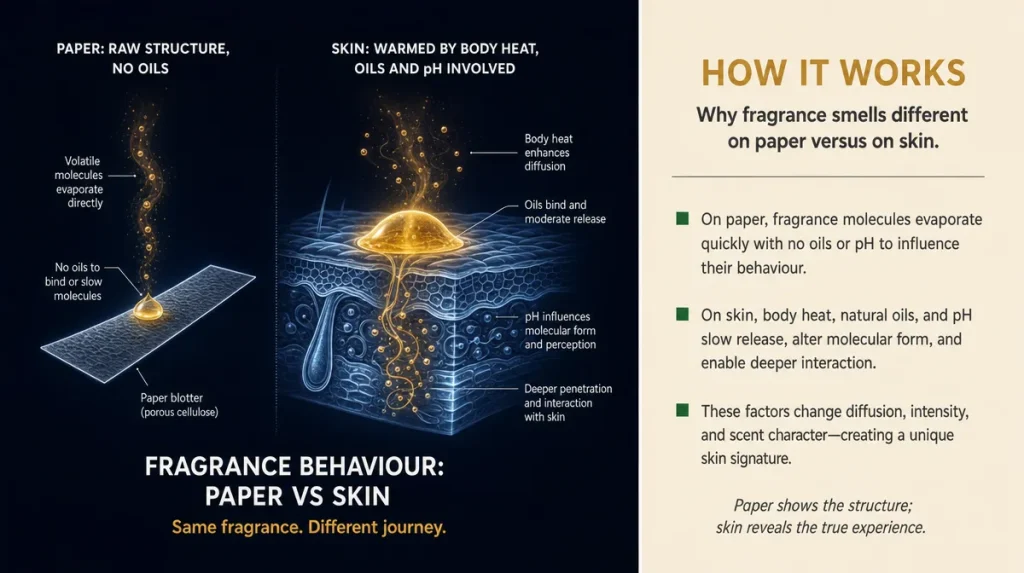
Fragrance houses test on paper blotters because paper is consistent. Your skin is not. Skin pH, natural oil production, and even diet and medication can shift how a fragrance reads once it meets you, sometimes considerably.
A drier skin type tends to hold fragrance oils less well, meaning scent may fade faster and read slightly differently than it does on oilier skin, where the natural oils act rather like a fixative. This is one reason two friends can spray the identical bottle and describe entirely different smells: one says it is soft and powdery, the other says it is sharp and citrus-forward, and both are, in a sense, correct.
A sensible method is to test on a paper blotter first to judge the raw structure of the fragrance, unclouded by your own skin chemistry, then apply a small amount to your wrist or inner elbow to see how it behaves once warmed by body heat. Give it at least thirty minutes before judging the skin version, since body heat accelerates the release of top notes further still.
The common mistake is testing several fragrances on the same small patch of skin in quick succession. By the third spray, your nose is fatigued and your skin is a confused mixture of three different formulas. Testers who assess fragrance for a living generally limit themselves to two or three scents per session, with a break in between, often smelling coffee beans or the inside of their own elbow to reset.
Where Cheaper Formulations Actually Cut Corners
Cost differences in fragrance are rarely about marketing alone, though marketing certainly plays its part. A meaningful share of the cost sits in the raw materials themselves. Natural extracts, such as rose absolute or genuine oud, are expensive to produce and are frequently replaced, wholly or partly, with synthetic equivalents that approximate the smell at a fraction of the cost.
This is not inherently a mark of poor quality. Many modern synthetic molecules are prized by perfumers precisely because they offer effects that nature cannot, and some of the most celebrated fragrances of the last fifty years lean heavily on synthetic aroma chemicals. The difference tends to show up in longevity and complexity rather than in the initial impression: a cheaper formulation may smell perfectly pleasant on first spray but collapse into a flat, single-note smell within an hour, because it lacks the layered base notes that keep a fragrance evolving.
Another area where corners are visibly cut is the base, or drydown. Good perfumery invests heavily in base notes, ingredients like musks, woods, and ambers that anchor the fragrance for its final hours of wear. Inexpensive formulations often thin out here, meaning the fragrance you smell at nine in the morning bears little resemblance to whatever faint trace remains by teatime.
A practical self-test: spray a fragrance in the morning and check it again at both midday and early evening. If nothing is left by midday beyond a faint alcohol note, the base is doing very little work.
What Realistic Longevity Looks Like, And How To Judge It Fairly
Reasonable expectations matter here. An eau de parfum applied to pulse points, the wrists, the base of the throat, the inside of the elbows, can reasonably be expected to remain detectable for four to eight hours on most skin types, fading gradually rather than disappearing at once. Central heating and radiator-warmed rooms, common in British winters, can accelerate this fading further, since heat encourages faster evaporation of fragrance molecules.
A fragrance that vanishes within an hour on you is not automatically a bad fragrance. It may simply be a poor match for your particular skin chemistry, your body’s oil production, or the season. Fragrance behaves differently in a damp, centrally heated January living room than it does on a warm July afternoon, and judging longevity fairly means testing in conditions similar to where you will actually wear it.
The fair way to judge longevity is to compare like with like: same skin, same day, similar humidity and temperature, ideally without layering other scented products such as body lotion over the top, since these will muddy the result. Testing a fragrance on a day when you have also applied a heavily scented moisturiser tells you almost nothing useful.
Most people judge longevity unfairly, blaming the fragrance for fading when the real variable was a hot shower two hours after application, or a heavily air-conditioned office. Give any fragrance a genuinely neutral test before deciding it does not last.
Separating Marketing Language From What You Can Actually Verify
Fragrance marketing leans heavily on story: a bottle inspired by a Mediterranean garden at dusk, a scent built around a single rare flower harvested at night. Some of this is genuine and reflects real formulation choices. A great deal of it is atmosphere, designed to make you feel something before you have even opened the box.
The words that tend to carry real information are concentration percentage where stated, the listed top, heart, and base notes, and whether the fragrance is described as eau de parfum or eau de toilette. The words that tend to carry marketing weight rather than verifiable fact include phrases like inspired by, in the spirit of, or evocative of, which describe a feeling the brand hopes you will have rather than an ingredient you can check.
Which? has previously published general guidance on reading fragrance labelling and understanding concentration terminology, useful background reading for anyone who wants the plain facts without the poetry. Good Housekeeping’s consumer advice pages have likewise covered practical points on storage and shelf life that most bottles never mention on their packaging.
A useful habit: read the listed notes before you read the story copy. If a fragrance claims a rose heart but the notes list none, treat the claim as atmosphere rather than formulation fact.
Testing Before You Commit, Properly This Time
Most fragrance counters, including those at Boots, Superdrug, and the beauty halls at Marks & Spencer, will happily give you a sample or allow you to spray a tester strip to take away, and this is worth using properly rather than rushing.
A method worth adopting: spray no more than two fragrances per visit, on separate wrists, and leave the shop before making any decision. Wear one on your skin for the rest of the day if you can, ideally a day without other strongly scented products in the mix, and see how you feel about it at six o’clock rather than at the till.
If a fragrance is available in a smaller bottle or a discovery size, buying that first rather than a full-size bottle is a sensible way to live with a scent for a fortnight before committing further, particularly with prices what they are and a full bottle representing a real outlay.
The mistake to avoid is buying because you liked how a fragrance smelled on someone else, whether a friend or a shop assistant. Skin chemistry is genuinely individual, and a fragrance that reads as warm and spicy on one person can read as sharp and soapy on another. There is no substitute for testing it on your own skin, over hours, not minutes.
Key Takeaways
A fragrance is not one smell but several, unfolding over hours, and the first impression is the least reliable part of the whole performance.
Concentration labels such as eau de parfum tell you about staying power and richness, not about whether a scent will suit you or smell sophisticated.
Your own skin changes a fragrance more than most people realise, which is why testing on paper and then on skin, over at least thirty minutes, gives a far fairer picture than a single spray at the counter.
A Short Checklist For Your Next Counter Visit
- Test no more than two or three fragrances per visit, with a break between each
- Smell the paper blotter first, then apply a small amount to skin and wait at least thirty minutes
- Avoid testing while wearing other strongly scented products, including scented moisturiser
- Check the fragrance again at midday and again in the early evening before judging longevity
- Read the listed notes and concentration percentage before reading the marketing story
- If unsure, buy a small or discovery size before committing to a full bottle
This article is provided for general information and does not constitute personal advice.
Individual experience of any fragrance may vary according to skin type and conditions of wear.