


Priya Sandhu, Staff Writer.
There is a particular moment at the bathroom sink, usually close to midnight, when a cotton pad comes away still grey with the day. Mascara in the creases, a smudge of concealer along the jaw, and a bottle of micellar water that promised to lift it all off in one pass. Most of us own two or three of these bottles at once: one bought on impulse at Boots, one a gift set leftover, one picked up because the label used the word gentle. Few of us could say, honestly, what separates a good one from a mediocre one beyond how it smells.
This guide is about reading a bottle the way someone trained in skin actually would: not by the marketing copy on the front, but by what is listed on the back, how it behaves on a cotton pad, and what your own skin tells you afterwards. One useful fact to start: micellar water does not clean skin the way soap does. It works by suspending oil-based debris inside tiny clusters of surfactant molecules called micelles, which is why it needs almost no rubbing to lift makeup, and why rubbing harder is usually a sign the product is wrong for your skin, not that you need more elbow grease.
- A short ingredient list often performs better than a long one, because fewer surfactants and solvents mean less residue left behind on the skin.
- The real test is the cotton pad, not the bottle: if it takes more than two gentle sweeps to lift a full face of makeup, the formula is underperforming for your skin type.
- Tightness after cleansing is not a sign it has worked; it usually means the surfactant has stripped more than makeup, and a rinse-off step may be missing from your routine.
What A Micellar Water Is Actually Doing To Your Skin
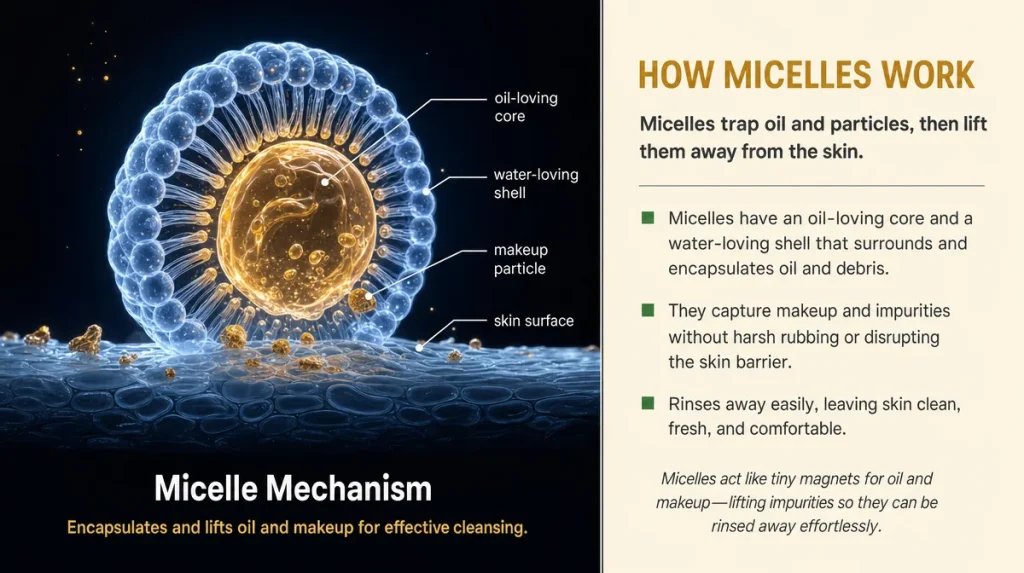
Think of a micelle as a very small string bag. One end of each surfactant molecule loves oil, the other loves water, and when enough of them cluster together in solution they form a sphere with oily grime tucked inside and water facing outwards. Swipe that solution across a cheek covered in sebum, sunscreen and foundation, and the oily end of each micelle grabs onto the makeup while the watery shell keeps the whole cluster suspended, ready to be wiped away on a cotton pad rather than smeared back into the pores.
This is also why a proper micellar formula needs almost no scrubbing. If you find yourself pressing hard or going over the same patch of skin five or six times, the micelle concentration in that bottle is probably too low to do the job, or the formula was diluted to hit a lower price point. A 2021 study in the International Journal of Cosmetic Science comparing surfactant concentrations in rinse-off and leave-on micellar formulas found that cleansing efficiency on oil-based pigments dropped sharply below a certain surfactant threshold, regardless of how the product was marketed on pack.
Reading The Ingredients List Without A Chemistry Degree
Ingredients on UK packaging are listed in descending order by concentration, water first in almost every micellar water, followed by the surfactants doing the actual work. Look for names such as poloxamer, PEG-40 hydrogenated castor oil, or lauryl glucoside sitting near the top of that list after water. These are the cleansing agents. If the first several ingredients after water are glycerin, panthenol and plant extracts before you reach anything resembling a surfactant, the formula is likely to be mild but may struggle with heavier, waterproof makeup.
A useful household comparison: a short ingredient list behaves a bit like a short recipe. Fewer components generally means fewer places for irritation to creep in, and fewer residues left on the skin after the water evaporates. Good Housekeeping’s consumer testing has long noted, in its general skincare guidance, that formulas with excessive fragrance or alcohol loads near the top of an ingredients list tend to correlate with reported stinging, particularly around the eye area. That is public guidance worth remembering next time a bottle smells strongly of rose or citrus.
The One-pad Test You Can Do Tonight
Here is a simple, at-home check. Apply your usual makeup as normal, then that evening use two cotton pads only. On the first pad, soak your current micellar water and sweep once across one side of your face, timing how many passes it takes to lift mascara and foundation fully. On the second pad, do the same with a different bottle, perhaps a sample or a friend’s.
Count the passes. A formula that needs one or two gentle sweeps per area is performing well. Anything beyond four or five passes, particularly around the eyes, suggests either the surfactant concentration is too low or the product was never designed for full-face makeup removal in the first place, and is better suited as a toner-style refresh. Note too whether the pad feels slightly oily after use, which is normal, versus bone dry, which can indicate the solvent has stripped the skin’s own lipids along with the makeup.
Where Cheaper Formulas Cut Corners
Budget micellar waters are not inherently poor, but the shortcuts tend to cluster in predictable places. The most common is simple dilution: more water, fewer active surfactants, which keeps the bottle feeling light and non-greasy but means it works less efficiently on heavier makeup, pushing you towards more product and more rubbing.
The second shortcut is relying on a single, cheap surfactant rather than a blended system. Blends of two or three mild surfactants tend to clean more thoroughly while remaining gentler than a single harsher one used at high concentration, because each does part of the job rather than one doing all of it. The third is fragrance used to mask a flat, slightly chemical base smell, which adds irritation risk without adding cleansing power. None of this makes a budget bottle unsafe. It simply means the reader doing the one-pad test above may need more passes, which is useful information in itself.
What Realistic Results Look Like, And How Fast
A well-matched micellar water should remove the bulk of a day’s makeup within the first minute of application, visible immediately on the cotton pad. What it will not do, even at its best, is replace a proper cleanse. Most dermatology guidance, including general advice published by the British Beauty Council on everyday skincare habits, treats micellar water as the first step of a double cleanse rather than the only step, particularly for anyone wearing SPF or long-wear foundation.
If you are judging whether a product is working over time, look for fewer visible residues on your pillowcase in the morning and less congestion around the nose and chin after a fortnight of consistent use, rather than expecting an overnight change. Skin takes time to show whether a cleansing routine suits it, usually somewhere between two and four weeks of consistent use before congestion patterns settle one way or the other.
The Tightness Myth, And What Your Skin Is Really Telling You
Many of us were taught that a squeaky, tight feeling after cleansing means the product has worked properly. It is worth unlearning this. Tightness after a micellar water usually means the surfactant has removed more than makeup, taking some of the skin’s own surface lipids with it.
A fair comparison is washing a wool jumper in the wrong detergent: it may come out clean, but also noticeably stiffer and less supple than before. Skin behaves similarly. If your face feels tight within minutes of using a micellar water, particularly in a centrally heated flat during a damp British winter when the air is already pulling moisture from skin, that is a signal to look for a formula with humectants such as glycerin or hyaluronic acid listed reasonably high on the ingredients panel, or simply to follow with a proper moisturiser rather than skipping it because the skin feels clean.
Marketing Language Worth Ignoring, And Language Worth Trusting
Terms like detoxifying, purifying or miracle water carry no regulated meaning on a cosmetic label in the UK and tell you nothing about formulation. They are marketing language, not clinical claims, and a product can use them while containing nothing unusual at all.
What is worth trusting: a clearly stated pH close to that of skin, usually printed as pH-balanced or similar on the label, and an ingredients list you can actually read without needing six attempts. Stylist and Marie Claire UK beauty desks have both, in general buying guidance over the years, pointed readers towards checking for alcohol denat. high on an ingredients list as a marker of a formula likely to feel drying over repeated use, particularly for anyone with already dry or reactive skin. That is the kind of detail that tells you more than any phrase on the front of the bottle.
Matching The Formula To Your Actual Skin, Not Your Skin Type On Paper
Skin type labels on packaging are a starting point, not a verdict. Someone with officially oily skin may still react badly to a high-alcohol formula in winter, when central heating is already drying the skin from the inside. Someone with officially dry skin may find a very rich, oil-based micellar water leaves a film that then traps makeup residue rather than lifting it.
The more reliable approach is to judge by how your skin behaves that week, not by a category printed on a bottle eighteen months ago. If your skin has been flaking or tight, look for the humectant-forward, fragrance-light formulas regardless of what the label calls your skin type. If it has been congested and oily, a formula with a slightly higher surfactant load, tested using the one-pad method above, will likely perform better than a label claiming hydrating on the front.
Key Takeaways
A micellar water works through micelles, tiny clusters that trap oil-based makeup and lift it with minimal rubbing, which means a good formula should never need heavy scrubbing to work. Reading the ingredients list after water, rather than the claims on the front of the bottle, tells you far more about how a product will actually perform. Tightness after cleansing is not proof of effectiveness: it is often a sign the formula has gone further than intended, especially in winter months when heating already dries the skin. Judge results over a fortnight of consistent use, not a single evening, and remember that for most people a micellar water works best as the first step of a cleanse rather than the whole routine.
A Quick Checklist For Next Time You Are Stood In The Aisle
- Check what comes straight after water on the ingredients list: look for recognisable surfactants, not just fragrance and extracts.
- Do the one-pad test at home before committing to a full bottle.
- Treat tightness as a warning sign, not a success marker.
- Judge a formula against how your skin behaves that week, not the category printed on the label.
- Follow with a rinse-off cleanse or a moisturiser if your skin ever feels stripped rather than simply clean.
- Ignore words like detoxifying or purifying; they carry no regulated meaning.
This article is for general information only and does not replace advice from a qualified dermatologist.
Individual skin responses vary, and results described here may not apply to everyone.