
Priya Sandhu, Staff Writer.
There is a drawer, or maybe a shelf in the airing cupboard, holding two or three hair dryers: the one that came free with a straightener set, the one your mother handed down, and the newer one you bought after the last started smelling faintly of hot plastic. None of them quite finishes the job in the time you actually have before work. So you type the same question late one evening: which hair dryer is genuinely worth the money. Before that question can be answered sensibly, it helps to know what a specialist actually checks first, and it is rarely the figure printed in bold on the box. A dryer’s wattage tells you how much electricity it draws, not how fast or how gently the air moves across your hair, and that second figure is the one that actually decides your drying time and your frizz.
- Wattage is not the whole story: airflow speed and motor type decide drying time and finish far more than the number printed on the box.
- Heat and airflow work as a pair: a dryer that runs hotter but moves air slowly can strain hair that a faster, cooler airflow would protect.
- Weight decides whether you finish the job properly: a dryer that tires your arm before your hair is dry tends to produce rushed, uneven results.
Why The Wattage Number On The Box Misleads You
Every hair dryer sold on the high street carries a wattage figure somewhere on its packaging, usually in bold, as if it were the headline spec. It is not. Wattage measures how much electricity the motor draws, not how effectively that electricity turns into moving air.
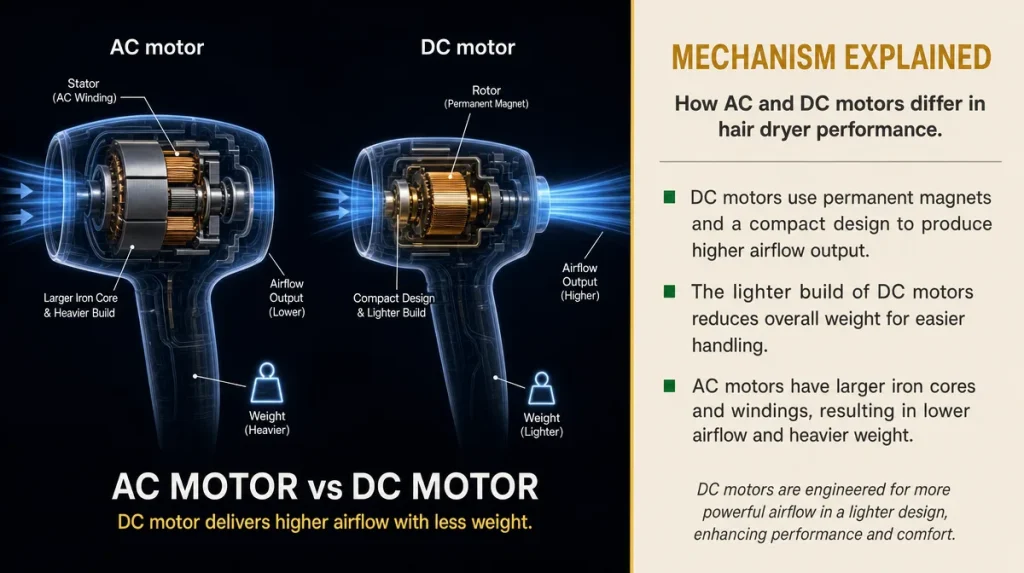
Two dryers rated at 2200 watts can behave quite differently on the same head of hair. One might push air quickly and steadily; the other might waste much of that power as heat rather than airflow. A specialist judging a dryer looks past the wattage sticker and asks what kind of motor sits inside: an AC motor, heavier and typically found in older or cheaper models, or a DC motor, lighter, usually quieter, and increasingly common in dryers sold at Boots and Superdrug.
Think of it the way you would compare two kettles. A more powerful kettle does not necessarily boil water faster if the element is poorly designed or the water path is inefficient. The number on the box is a starting point, not a verdict.
A quick way to test this in a shop, where handling floor models is usually allowed, is to hold your palm about twenty centimetres from the nozzle on the highest airflow setting. A dryer with a strong, well-designed motor produces a noticeably firm, even stream. One that whistles or feels weak despite a high wattage figure is very likely losing energy to heat rather than airflow, which means longer drying times and more heat exposure for your hair.
Reading The Heat And Airflow Balance
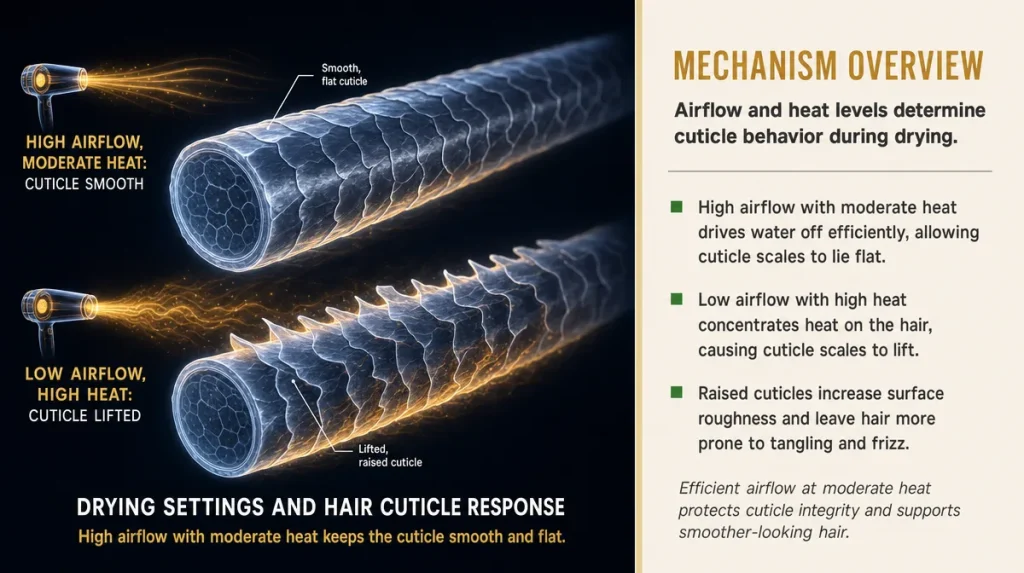
Heat gets the credit for drying hair, but airflow does most of the actual work. It is the same principle behind laundry on a washing line: a jumper dries faster on a breezy, cool day than in a warm, still room, because moving air carries moisture away far more efficiently than heat alone.
A 2019 study in the International Journal of Trichology measured hair damage under different combinations of heat and airflow and found that higher airflow at moderate heat produced less cuticle damage than lower airflow at high heat, for a comparable drying time. In practical terms, a dryer that lets you run strong airflow alongside a medium heat setting is usually doing your hair a favour compared with one that only performs well at its hottest setting.
Specialists check for at least two or three distinct heat settings and, separately, two or three airflow speeds, because the two should be adjustable independently. A dryer offering only a single combined ‘high’ and ‘low’ setting gives far less control than the dial suggests.
The self-test is simple. Dry a small section of hair at the highest heat and airflow together for thirty seconds, then repeat on a similar section with medium heat and high airflow. If the second combination leaves the hair similarly dry but visibly less frizzed at the ends, the airflow is doing more of the work than you assumed, and the heat can safely be dialled down for the rest of your head.
What Ionic Technology Actually Changes, And What It Does Not
Ionic technology is printed on the box of almost every mid-range and premium dryer, and it is one of the most exaggerated claims in the category. What it does, credibly, is emit negative ions that break large water droplets on the hair shaft into smaller ones, which dry faster and are said to leave the cuticle smoother, reducing static and visible frizz.
The household analogy is a car windscreen in the rain. Large drops sit and streak; a fine mist clears almost instantly and leaves less residue behind. Ionic dryers are aiming for that fine mist effect on the water sitting on your hair’s surface.
What ionic technology does not do is repair damaged hair, add moisture that was never there, or make a weak motor perform like a strong one. A dryer with poor airflow and an ionic function will still take longer to dry your hair than a dryer with strong airflow and no ionic function at all. General guidance from the Good Housekeeping Institute on hair tools has long noted that finish and feel are best judged by handling an appliance and observing its results, not by reading its feature list, which is sound advice for any electrical purchase made on the strength of a badge.
To judge whether ionic technology is doing anything noticeable on your own hair, dry one side of a fresh wash with the setting switched on and the other with it off, keeping heat and airflow identical. Static flyaways and drying time are the two things worth comparing; shine is harder to judge fairly under bathroom lighting.
Weighing A Dryer Before You Weigh Up Its Features
A dryer that feels light in a shop, held for ten seconds at chest height, can feel considerably heavier after eight minutes held above your head. Specialists weigh a dryer with the diffuser or concentrator attachment fitted, because that is the weight you will actually be lifting, and they hold it at drying angle rather than at rest on a counter.
Weight matters because a tired arm changes behaviour. Sections get rushed, roots get less attention than ends, and the dryer tends to drop closer to the hair than intended, increasing heat exposure exactly where care was meant to be taken. Research on repetitive overhead tasks published in the journal Applied Ergonomics found that sustained arm elevation, even at modest weights, significantly increased reported fatigue within minutes, which tracks with most people’s experience of a long blow-dry.
The self-test is worth doing before buying, not after. Hold the dryer, attachment fitted, at the angle you would actually use it, arm raised as if drying your crown, for a full sixty seconds. If your arm is trembling or dropping by the end of that minute, the dryer is likely to cause the same problem at minute six or seven of a real drying session, not just minute one.
Judging Nozzle And Diffuser Attachments Properly
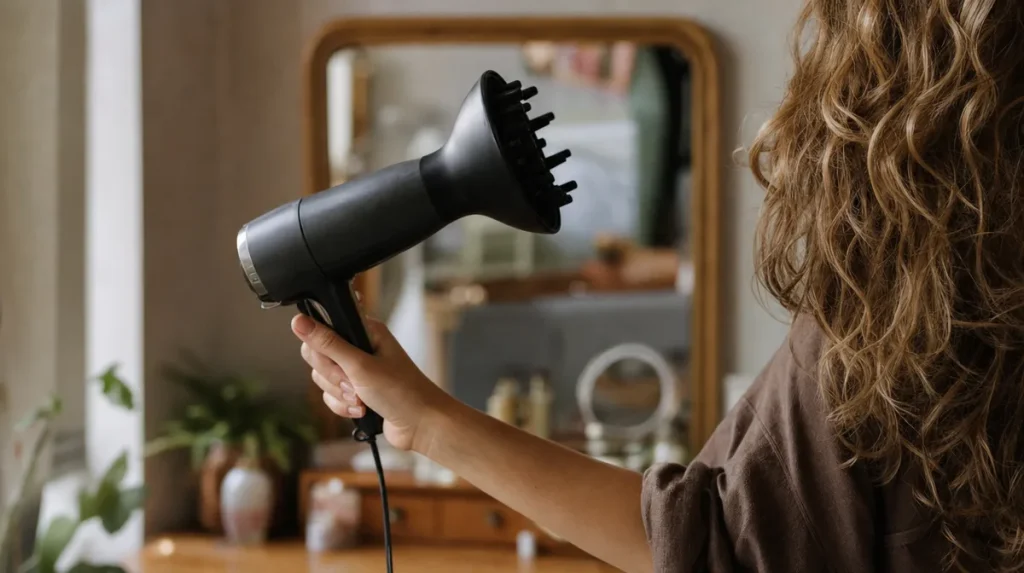
A concentrator nozzle narrows the airflow into a directed stream, useful for smoothing and for styling with a brush. A diffuser spreads the airflow across a wider area with less direct force, generally preferred for curly or wavy hair, where a direct blast disrupts the curl pattern.
The mistake most buyers make is judging these attachments by how sturdy they feel in the hand rather than by how they change the airflow itself. A narrow concentrator on a weak motor still produces a weak, if directed, stream. A wide diffuser on a strong motor can still deliver enough airflow to dry curls efficiently without disturbing them, because the strength of the underlying motor, not the shape of the attachment, decides how much air is available to redirect.
Fit matters more than most packaging suggests. An attachment that wobbles or fails to click firmly into place will vibrate during use, which is irritating and often a sign of looser manufacturing tolerances elsewhere in the appliance. Specialists check this by twisting the attachment gently once fitted; it should not move independently of the barrel.
Cord Length, Swivel And The Small Frustrations
None of this is glamorous, but it decides whether a dryer is pleasant to use every morning. A cord under two metres is workable at a dressing table close to a socket, but becomes a genuine obstacle in a bathroom where the nearest socket sits behind the door.
A swivelling cord, one that rotates freely where it meets the handle, prevents the kind of twisting that eventually stresses the internal wiring. Cheaper dryers often skip this feature entirely, and the sign of a fixed cord is a handle that resists turning smoothly when you rotate the barrel to reach the underside of your hair.
None of this shows up in a spec sheet comparison, which is exactly why it gets overlooked until the dryer has been in daily use for a few months and the cord has started to fray near the plug.
Listening For The Noise Problem Before You Buy It
Noise is rarely mentioned on packaging, yet it is one of the most commonly regretted purchases. A dryer used daily in a shared flat, or a house with sleeping children, needs to be judged on sound as much as on drying time.
DC motors are, as a general rule, quieter than AC motors at comparable airflow strength, which is one reason the newer generation of dryers sold across Boots, Superdrug and Amazon.co.uk tend to advertise their motor type prominently. Loudness alone is not the whole issue either; pitch matters. General consumer guidance from Which? has noted that a high-pitched whine is reported as more irritating over a sustained period than a lower, steadier hum at a similar decibel level.
If possible, test a dryer in the shop on its highest setting and note whether the sound is a hum or a whine. A whine that seems tolerable for ten seconds in a shop can feel considerably less tolerable after the fifth consecutive morning.
Judging Results Properly, And When To Worry
The clearest sign a dryer is working well for your hair is not shine, which depends heavily on light and styling product, but drying time relative to the heat used. Hair that takes the same time to dry as before but at a noticeably lower heat setting is a genuine improvement, not a coincidence.
A reasonable benchmark for mid-length hair, based on general guidance published by testing bodies such as Which?, sits somewhere between eight and twelve minutes with a decent dryer and brush technique, though thickness and hair type shift this considerably. If a dryer consistently pushes you past fifteen minutes on its highest settings, the issue is very likely the motor, not your technique.
Watch for two warning signs rather than obsessing over speed alone. First, a persistent burning-plastic smell after the first few uses, which should fade after an initial break-in period and is a fault if it does not. Second, visible dulling or increased breakage at the ends after a few weeks of regular use, which points to heat concentration rather than airflow doing the drying, regardless of what the settings dial claims to offer.
Results also depend on habits that have nothing to do with the appliance. Drying from roots to ends, keeping the dryer moving rather than holding it still on one section, and finishing on a cooler setting before styling all matter more than most people expect, and no dryer, however well engineered, fully compensates for skipping them.
Key Takeaways
- Wattage tells you power draw, not performance: check motor type and airflow strength instead.
- Heat and airflow should be adjustable independently; strong airflow at moderate heat tends to protect hair better than high heat alone.
- Ionic technology may reduce static and speed drying slightly, but will not fix a weak motor or repair damage.
- Weight matters most at the angle you actually use the dryer, not at rest in a shop.
- A concentrator suits smoothing; a diffuser suits curls, but both depend on the motor behind them.
- Noise and cord design are unglamorous but decide daily usability more than any spec sheet line.
- Judge results by drying time at a lower heat, not by shine alone, and watch for a persistent smell or increasing breakage as genuine warning signs.
A Quick Checklist Before You Buy
- Hold the dryer with its attachment fitted, arm raised, for a full minute before deciding on weight.
- Check for at least two independent heat settings and two airflow speeds.
- Test loudness in person where possible, noting whether the sound is a hum or a whine.
- Ask whether the motor is AC or DC, and expect DC to run lighter and quieter at a similar price point.
- Time your current drying routine once, so you have a real benchmark to compare against.
- Treat any ‘up to’ claim on packaging as a laboratory best case, not a guarantee for your own hair type and thickness.
This article is general information and does not replace advice from a qualified professional.
Individual results vary depending on hair type, thickness and drying technique.