

Tom Whitfield, Features Reporter.
You are standing in front of the mirror at half past seven, straighteners in hand, and the same section of hair has gone through them three times already. It still springs back. Somewhere in a drawer are two older sets that promised the same thing and did not deliver it either.
Most of what decides whether a straightener works has nothing to do with the number on the box or the celebrity endorsing it. It comes down to how evenly a plate reaches temperature, how well it holds that temperature under load, and how the plate surface treats the hair shaft as it passes through. One genuinely useful fact before anything else: a plate that reads 200°C on a display can still have patches running 30 degrees cooler, which is why some sections take three passes and others take one. This guide is about learning to spot the difference yourself, before you spend a penny.
- Recovery time matters more than the top temperature setting: a plate that returns to heat quickly between sections straightens in fewer passes and does less cumulative damage.
- Plate material changes how hair glides, not just how hot it gets: rougher surfaces snag and require repeated passes, which is often mistaken for a hair problem rather than a tool one.
- Width should match your head, not your hair length: narrower plates suit fine or short styles and give better control near the root, while wider plates cover ground faster on thick, long hair.
Why The Same Setting Behaves Differently On Different Heads
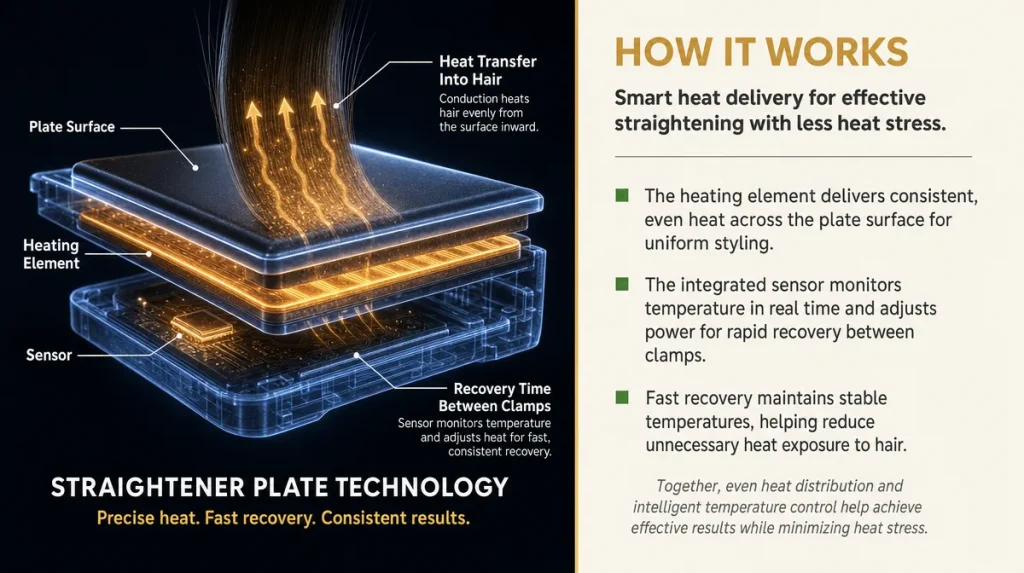
Every straightener display shows one number, but that number describes the target, not the reality at the plate surface. Think of it the way a domestic oven works: set it to 180°C and the thermostat cycles the element on and off to hover near that mark, but open the door too often and the temperature dips before it recovers.
Straightener plates do something similar. As you clamp down on a section of hair, heat transfers out of the plate and into the hair shaft, and the plate’s internal heater has to catch up before the next section gets the same treatment. Cheaper units recover slowly, so the fifth section of a full head is genuinely cooler than the first, even though the dial has not moved.
A 2021 study in the International Journal of Trichology measured surface temperature drop across repeated clamping cycles and found some devices lost over 15 per cent of their set temperature within four consecutive sections. That drop is invisible to the user. It simply feels like the hair “needs another pass”, which then adds heat exposure that a better-recovering plate would not have required.
This is the single most useful thing to understand before buying: fast, consistent recovery beats a high maximum temperature. A straightener capped at a lower ceiling but with strong recovery will often outperform one boasting a higher number on the box.
Reading A Plate Surface Before You Switch It On
Plate coatings get marketed with a great deal of vocabulary: ceramic, tourmaline, titanium, ionic. Some of this describes the plate itself; some describes a coating sprayed onto a cheaper base underneath.
A simple household comparison helps. Think of a good non-stick frying pan versus one where the coating has started to wear through in patches. Food glides in the first and catches in the second, even though both started life looking identical.
Hair behaves the same way against a plate. A smooth, evenly finished surface lets the hair shaft slide through with light tension. A rough or unevenly coated one grips slightly, which means more heat contact time per section and more mechanical pulling on the cuticle, the hair’s outer layer.
You can test this yourself in a shop before buying, if the display unit is switched on. Run a single strand of your own hair, or a tissue if hair is not permitted, through the plates slowly. Resistance you can feel with your fingers is resistance your hair will feel too, magnified by heat.
Beware of coating claims used as a stand-in for actual smoothness. “Infused with argan oil” on a plate housing tells you almost nothing about how the metal itself behaves; oil infusions wear off within weeks of use, while the underlying plate finish does not change.
The Width And Shape Mistake Almost Everyone Makes
Buyers tend to choose plate width based on hair length, when it should be chosen based on hair texture and the styles actually worn.
A wide plate, generally above 3.5cm, moves through long, thick hair efficiently, covering more surface per pass. But it is clumsy near a fringe, around the hairline, or on layered short styles, where a narrower plate, closer to 2.5cm, gives far more control and reduces the risk of catching hair that has not been sectioned.
The mistake is buying width for speed and then finding it unusable for detail work. A good compromise many stylists suggest for mixed styling needs is a mid-width plate around 3cm, and rounded plate edges rather than sharp corners, which reduce the visible crease line some straighteners leave at the point where the plate ends.
Self-test: hold your current straightener up to a mirror and look at your parting width and the shape of your fringe, if you have one. If the plate is noticeably wider than either, that is very likely where your styling frustration is coming from, rather than the temperature setting.
What Temperature Your Hair Actually Needs
Fine, colour-treated or previously bleached hair does not need the same heat as thick, virgin, coarse hair, and using the same setting on both is one of the most common sources of damage that customers describe as “my straighteners burning my hair” when the tool was never really the sole cause.
A general guide many trichologists reference: fine or damaged hair sits comfortably between 130°C and 165°C; normal, healthy mid-density hair between 165°C and 185°C; and thick, coarse or very curly hair may need 185°C to 210°C to hold a style at all. These are starting points, not rules, and results may vary by individual hair condition.
The practical test is simple. Start at the lower end of your likely range and do one section. If it takes more than two slow passes to straighten cleanly, move up by ten degrees rather than repeating passes at the same heat, which does more cumulative damage than a slightly higher single pass.
A straightener worth buying will hold a genuinely stable low setting, not just a high one. Many cheaper units are calibrated around their maximum heat and become unreliable once turned down, drifting several degrees either side of the display reading.
Where The Marketing Gets Ahead Of The Mechanism
Ionic technology is the phrase that does the most work in straightener marketing, and the most exaggeration. The genuine mechanism is modest: some plates emit negative ions that are claimed to reduce static and marginally smooth the hair’s outer cuticle by neutralising the positive charge that causes frizz and flyaways.
What it does not do is repair damage, seal split ends, or replace the need for heat protection. A 2019 review in the Journal of Cosmetic Science noted that ionic emission from consumer straighteners is generally too low in volume to meaningfully alter the hair shaft’s moisture content, though it may visibly reduce static in low-humidity conditions such as centrally heated homes in winter.
Digital displays showing temperature to the exact degree are another area worth scepticism. The number is only as accurate as the sensor reading it, usually placed at one point on the plate, not distributed across the surface. A precise-looking display does not guarantee an evenly heated plate; it guarantees a precisely measured single point on it.
Treat claims about “salon results at home” as a promise about styling technique as much as hardware. A straightener is one part of the outcome. Section size, hair preparation and pass speed do the rest.
The Heat Protectant Step People Skip
Heat protectant spray is often treated as optional, an upsell rather than a genuine step, but the underlying chemistry is straightforward enough to explain simply.
Hair is largely keratin protein, and high heat can cause the moisture within the shaft to boil rapidly, creating tiny voids that weaken the structure, sometimes visible later as breakage or a rough texture along the mid-lengths. A protectant spray works chiefly by coating the shaft with a thin barrier that slows moisture loss and heat transfer by a few crucial seconds, similar to the way a tea towel around a hot dish lets you handle it without the same instant heat contact.
The Good Housekeeping Institute’s general styling guidance has long recommended applying protectant to towel-dried or fully dry hair before any heat tool, never as a finishing spray afterwards, since sprayed-on formulas need a moment to form that barrier before heat is applied.
Skipping this step does not always show up immediately. Damage from repeated unprotected straightening tends to accumulate over months, appearing first as dullness and difficulty holding a style, well before visible breakage. If your hair has started resisting styling more than it used to, the pattern is worth noting before assuming the straightener itself has failed.
Judging Results Properly, And When To Stop
A good straightening pass should hold for a full day without humidity intervention, longer in the drier air of central heating, shorter in damp weather or a British summer that rarely gets properly hot. If a style drops within a couple of hours indoors, the issue is more often preparation, section size or product build-up than the straightener’s heat output.
A fair self-test: straighten one section twice, at a five-minute interval, without touching the temperature dial. If the second pass over the same hair still meets resistance, the plate has not recovered its heat, which points to the appliance rather than your hair or technique.
Watch, too, for a burning smell that is sharper or more chemical than the usual faint scent of heated hair. That specific signal, alongside visible smoke rather than steam, generally indicates the plate is running hotter than its display suggests, and is worth taking seriously rather than pushing through a style.
Longer term, judge a straightener by how your hair behaves between uses, not only during styling. Increasing dryness at the ends, a rougher feel along the mid-lengths, or hair that takes visibly longer to straighten each month are all signs worth tracking over several weeks rather than a single bad hair day.
Reading Reviews And Buying Guides Without Being Misled
Comparative test results from established consumer publications, such as Which?’s lab-scored appliance verdicts, are genuinely useful because they measure plate temperature consistency under controlled conditions rather than relying on marketing copy. Reading how a device performed on even heating across the full plate length tells you more than a five-star average from a retail listing.
Be wary of reviews that praise a straightener purely on speed of styling without mentioning heat consistency, since a device that straightens quickly by running uniformly very hot may simply be trading speed for long-term hair condition.
In shop, ask whether you can see the appliance switched on and running for a minute before committing, particularly around Boxing Day sales periods when older stock is often reduced and worth a proper look rather than a quick decision. A chemist or high-street pharmacy counter rarely stocks styling tools for testing, but larger beauty halls generally do, and staff are usually willing to demonstrate.
Key Takeaways
Choosing a straightener well is mostly a matter of understanding heat recovery and plate finish, rather than chasing the highest number on a display.
A tool that holds a stable, appropriate temperature and glides smoothly will need fewer passes, which is the real determinant of long-term hair condition, more so than any single technology named on the box.
A Practical Checklist Before You Buy Or Judge Your Current Straightener
- Test recovery: straighten the same section twice with a short pause and see whether the second pass meets more resistance
- Run a strand through the plates in shop to feel for drag or catching
- Match plate width to your fringe and parting, not to your hair’s overall length
- Choose a setting suited to your hair’s actual condition, starting low and adjusting by ten degrees
- Apply heat protectant to dry hair before styling, not after
- Watch for a sharp, chemical burning smell rather than the usual faint heat scent
- Track hair condition over weeks, not single sessions, as the real measure of whether a tool suits your hair
This article is for general information only and does not replace advice from a qualified professional.
Individual hair type and condition vary, so results and suitable settings will differ from person to person.