


Tom Whitfield, Features Reporter.
Most women’s bathroom shelves hold at least two foundations that were worn once and abandoned: one too orange, one that vanished by lunchtime, one that sat in the creases beside the nose like a small warning. If you have stood under the harsh light of a chemist’s bathroom mirror, bottle in hand, wondering why the shade that looked fine on your wrist turned grey on your jaw, you are not doing anything wrong. You are doing it without the handful of facts that actually decide whether foundation works: how light behaves on skin, why a formula that suits your friend can fail on you, and what the label is and is not telling you. This guide walks through the parts that matter, in the order you would actually use them, so the next bottle you buy is the last one you regret.
- Undertone, not depth, causes most colour-match failures: two foundations can be the same shade number and still clash because one leans warm and one leans cool.
- Finish decides comfort more than coverage does: a matte formula on dry skin will crease and cling long before a sheer, hydrating one on the same face will.
- Skin prep changes wear time more than the foundation itself: an unbalanced base is the single most common reason foundation slides off by early afternoon.
Finding Your Undertone In Daylight
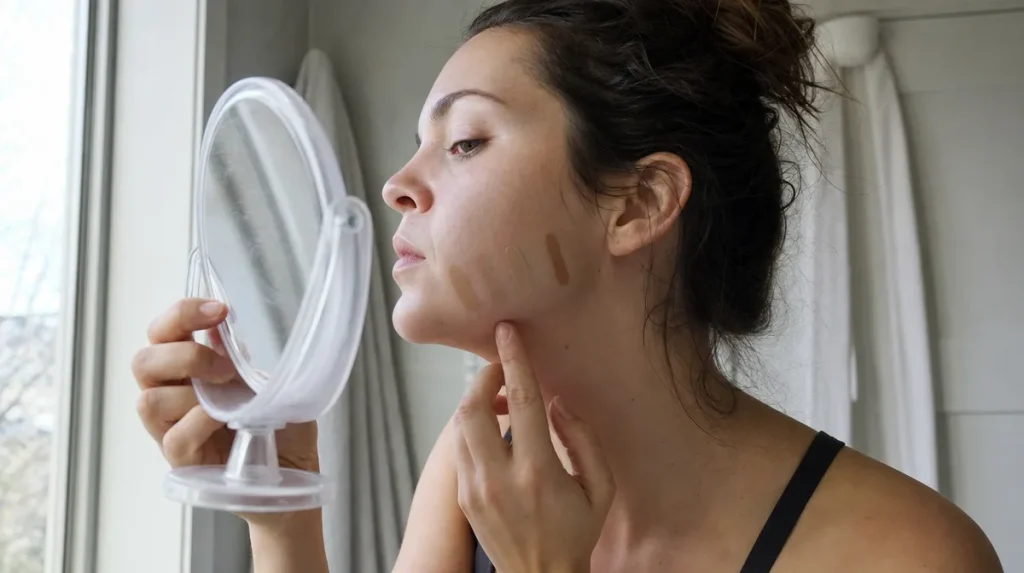
Shop lighting is the enemy of a good match. Fluorescent strips in a chemist can push almost any foundation towards grey or orange, which is why testing near a window, even for thirty seconds, matters more than any swatch chart on the shelf.
Undertone is separate from how light or dark your skin is. Think of it like the base coat under a paint colour: two walls can be painted the exact same shade of blue, but one was primed with a warm undercoat and one with a cool one, and the finished colour reads differently in the room. Skin works the same way. Warm undertones carry more yellow or golden cast, cool undertones carry more pink or red, and neutral sits between the two.
A simple self-test: look at the veins on the inside of your wrist in daylight. Greenish veins tend to suggest warm undertones, bluish veins suggest cool, and if you genuinely cannot decide, you are likely neutral, which is good news, because neutral undertones have the widest choice of formulas that will sit well.
The mistake almost everyone makes is choosing a shade purely by depth, the lightness or darkness, and ignoring undertone entirely. This is how a foundation ends up looking correct on the back of the hand and wrong on the face by mid-morning, because the jawline and neck often carry a different undertone reading to the inner wrist. Test along the jaw, not the hand, and check it again once it has settled for a few minutes.
Matching Shade Without A Patch-test Disaster
Once undertone is roughly sorted, shade-matching is about patience rather than guesswork. Apply a small amount along the jaw and blend it into the neck, never just onto the back of the hand, and walk to a window or step outside if you can. A shade that disappears into the skin at the jawline, rather than sitting as a visible line, is doing its job.
Skin also oxidises after application, meaning some formulas shift slightly darker or warmer over twenty to thirty minutes as they react with natural oils. This is normal and expected, not a fault, but it does mean the shade that looks perfect the moment you apply it may not be the shade that looks perfect an hour later. Give any new foundation at least half an hour before deciding.
A practical habit worth adopting: many counters and some online retailers, including Look Fantastic and Boots, offer small sample sizes or sachets before committing to a full bottle. Buying a full-size bottle on a single quick test is the single most common route to a wasted purchase sitting unused on a shelf.
Choosing A Finish And Coverage For Your Skin Type
Coverage and finish are two different decisions, though shoppers often conflate them. Coverage is about how much of the skin’s natural tone and texture is concealed: sheer, medium or full. Finish is about how the surface looks once it has settled: matte, dewy or satin.
Dry skin, particularly in the damp British winter when central heating pulls moisture from the air indoors, tends to look better in a dewy or satin finish, because matte formulas often contain more oil-absorbing powders that can cling to dry patches and emphasise flaking. Oilier skin, by contrast, often benefits from a matte or semi-matte finish, since a dewy formula can slide and look shiny by midday, particularly around the T-zone.
Think of finish like choosing between gloss and matt paint for a wall with a few dents in it: gloss paint reflects light and shows every imperfection, while matt paint absorbs light and softens them. Skin behaves in a similar way. A dewy finish reflects more light, which can look lovely on smooth, well-hydrated skin but draws attention to texture on drier or more textured skin. A matte finish absorbs light and can flatten texture, but on very dry skin it can look chalky.
A quick self-test: press a clean finger gently onto your cheek after your usual moisturiser has absorbed. If it feels slightly tacky or shiny, you likely lean oily to combination. If it feels tight or a little dry to the touch, you likely lean dry. Choose your finish accordingly, rather than by what a friend recommended.
The Application Tools That Actually Change The Result
The tool matters almost as much as the formula. A damp sponge, a brush and fingers each deposit foundation differently, and none is universally correct.
Fingers warm the product and push it into the skin quickly, which suits sheer, lightweight formulas and gives the most natural, skin-like result, but it can be harder to control on oilier skin, where fingers can shift product around rather than blend it evenly.
A damp sponge, dabbed rather than dragged, tends to give the most even, buildable finish because it absorbs excess product rather than pushing it around, which is why many make-up artists reach for one on full-coverage days. The water in the sponge dilutes the formula slightly, which helps avoid a heavy, cakey look.
A brush gives the most control and the most even, airbrushed coverage, particularly with fuller-coverage formulas, but it can leave visible streaks if the bristles are too stiff or the product is applied too thickly before blending.
Whichever tool you use, the most common mistake is applying too much product at once and then trying to blend it away, rather than building thin layers gradually. Start with less than you think you need. It is always easier to add than to remove.
Prepping Skin So Foundation Does Not Crease Or Fade
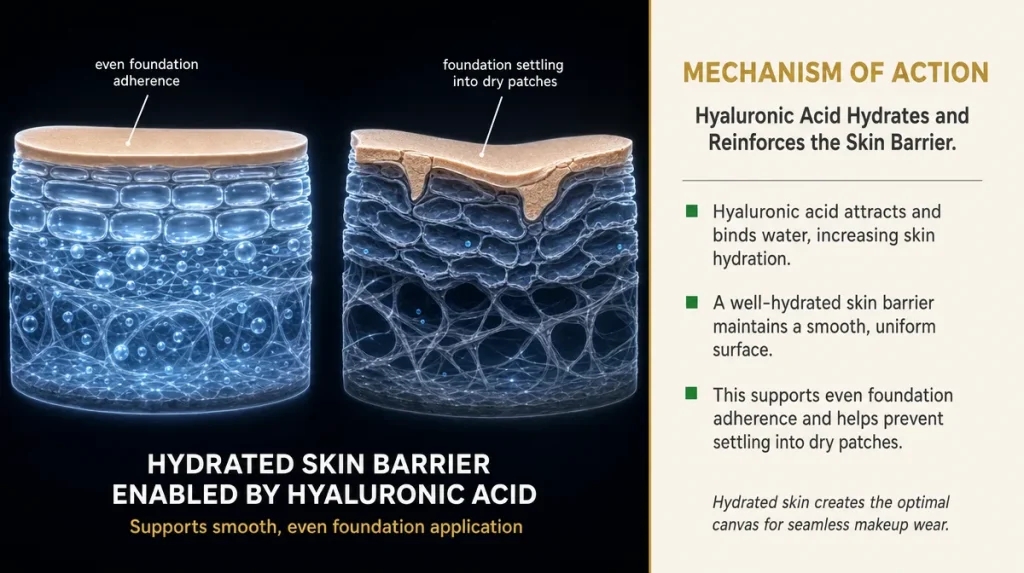
Foundation sits on top of whatever is happening underneath it, and an unbalanced base is the most common, most fixable reason it fails to last. If skin is dehydrated, foundation has nothing even to grip onto and will cling to dry patches within hours. If skin is left too damp or under-set, foundation can slide.
A simple order works for most people: cleanse, moisturise, allow a few minutes for the moisturiser to sink in fully, then apply foundation. Rushing the gap between moisturiser and foundation is one of the most common mistakes, because foundation applied over half-absorbed moisturiser tends to slip rather than sit.
A 2021 study in the International Journal of Cosmetic Science found that skin hydration levels measured before make-up application correlated with longer-lasting, more even foundation wear over an eight-hour period, which supports what make-up artists have long said anecdotally: prep decides staying power more than the foundation brand does.
During the colder months, when central heating dries out indoor air more aggressively than the cold outside does, skin often needs a slightly richer moisturiser than in summer, even for those who consider themselves oily. Adjusting moisturiser with the seasons, rather than the foundation itself, is often the more useful fix.
What Ingredients Matter Versus What Is Marketing
Ingredient lists on foundation bottles are often used more for marketing than for meaningful difference. A few genuinely change how a formula behaves, and most of the rest is noise.
Silicones, often listed as dimethicone, create the smooth, blurred finish many mattifying foundations rely on. They are not harmful for most skin types, though some people find they feel heavy or can trap heat on very warm days.
Hyaluronic acid, when included in a foundation rather than a serum, is present in far smaller amounts than in a dedicated hydrating product, so it may help slightly but should not be relied upon as your only source of hydration.
SPF included within foundation is genuinely useful, but the amounts are often too low, or too unevenly applied, to count as full sun protection on their own. Public health guidance, including advice publicised by the British Beauty Council on sun safety, generally recommends applying a dedicated SPF product underneath make-up rather than depending on the SPF stated on a foundation bottle, since most people do not apply enough foundation to reach the tested protection level. In the UK’s short, unreliable summer, this becomes a seasonal concern rather than a year-round one, though those with fair skin or outdoor routines may want SPF underneath throughout the year.
Buzzwords such as “clean”, “natural” or “dermatologist-developed” have no regulated definition in cosmetics and can mean very little in practice. Reading the first five ingredients, which make up the bulk of the formula, tells you more than any word on the front of the bottle.
Setting And Touching Up Through The Day
Setting powder is not compulsory, and using it everywhere on the face when you do not need to can undo a carefully chosen dewy finish. It is most useful on areas that move and produce oil, typically the T-zone, rather than pressed all over.
A light dusting with a large, soft brush, applied only where shine tends to build, tends to look far more natural than a full, even layer across the whole face, which can settle into fine lines by the afternoon, particularly around the eyes.
For touch-ups, blotting papers or a light dab of the same foundation on a clean fingertip generally refreshes the look better than adding more powder on top of powder, which is a common mistake and one that tends to make midday skin look heavier and more obviously made-up than it did that morning.
A useful habit for anyone who commutes or works long hours under office lighting: check your face around midday under a window, if one is available, rather than under artificial light, since indoor lighting can make a perfectly fine foundation look patchier or shinier than it actually is.
Key Takeaways
Undertone matters more than shade depth, and it is best judged along the jaw in daylight, not on the back of the hand under shop lighting. Finish should follow your skin type, dewy or satin for drier skin, matte or semi-matte for oilier skin, rather than following what looks fashionable. However you apply it, thin layers beat one heavy one, and prepped, well-moisturised skin will always outperform an expensive formula applied over a dry or unsettled base. SPF within foundation is a helpful extra, never a replacement for a dedicated sun product, particularly once the British summer actually arrives.
A Quick Checklist Before You Buy
- Test along the jaw in daylight, not on the hand under shop lighting
- Wait twenty to thirty minutes before judging a new shade, since most formulas oxidise slightly
- Choose finish by how your skin feels a few hours after moisturiser, not by trend
- Apply thin layers and build up, rather than starting heavy
- Prep with a fully absorbed moisturiser first, adjusting richness for the season
- Read the first five ingredients rather than the front-of-bottle claims
- Keep a dedicated SPF underneath make-up rather than relying on the foundation’s stated protection
This article is general information and does not replace advice from a dermatologist or qualified skin specialist.
Individual results and skin responses vary, and what suits one skin type may not suit another.