


Ellie Marsden, Beauty Editor.
You know the moment. Coffee at ten, and by half past your lipstick has migrated to the rim of the cup, leaving your actual mouth looking bare and slightly bruised. There’s a drawer somewhere in your flat with four or five ‘long-wear’ lipsticks in it, each bought on a promise, each abandoned after one wear because it dragged, or dried, or simply didn’t do what the label said.
Here’s the useful bit before we go any further: most long-wear formulas work by leaving a thin film of pigment on the lip once the liquid carrier evaporates, which is why so many of them feel wet on application and then set hard. Understanding that one mechanism explains almost everything else about how these products behave, and how to judge them properly rather than by marketing copy alone.
This piece won’t point you towards a product. It will teach you what to look for on the label, what to test in the shop before you buy, and how to tell a genuine formulation advance from a repackaged old idea with a new name.
- The transfer-resistant formulas that last longest work by drying to a film, which is exactly why they can feel uncomfortable if you buy the wrong texture for your lips.
- Colour payoff on the back of your hand tells you almost nothing about all-day wear; you have to test it on lips, through food and drink, to know.
- Most of the marketing language on long-wear packaging (12-hour, transfer-proof, second-skin) is unregulated wording, not a laboratory standard, so it’s worth learning to read past it.
How Long-wear Formulas Actually Work
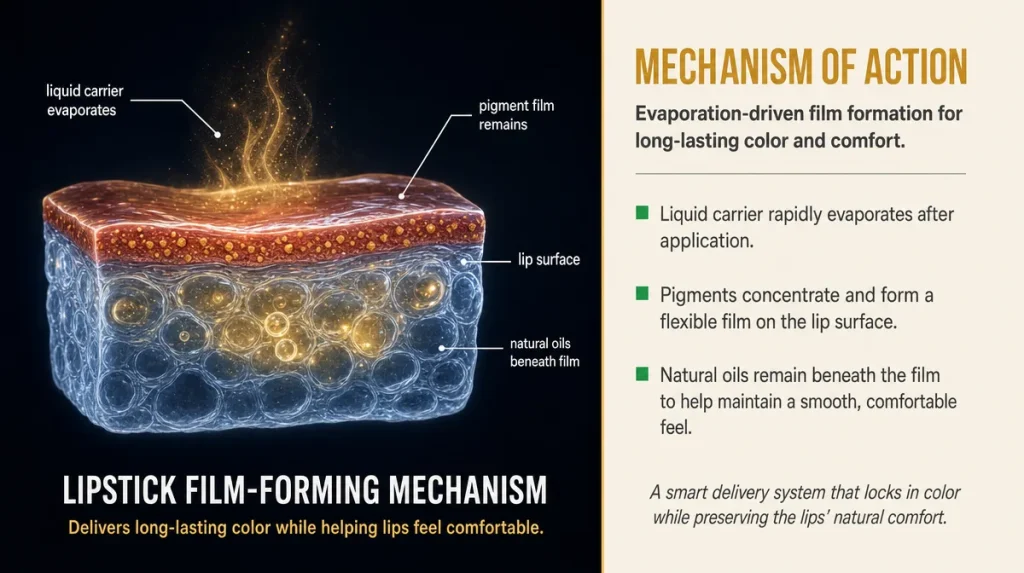
Most lipsticks that claim serious staying power rely on a simple trick: a fast-evaporating liquid carrier, often a silicone or a light oil blend, suspends the pigment and glides it onto the lip. Within a minute or two, the liquid part evaporates and what’s left behind is a thin, tinted film sitting on the surface of your lips rather than soaking into them.
Think of it like painting a fence with a quick-drying varnish rather than an oil-based stain. The varnish sits on top and resists water because it has physically sealed itself; the stain soaks in and still needs the wood’s own texture to hold it. A long-wear lipstick is the varnish. That’s exactly why it can transfer less onto a wine glass, and exactly why it can feel tight or flaky if your lips are already dry, because there’s nothing underneath the film to keep it flexible.
A 2021 study in the International Journal of Cosmetic Science looked at film-forming lip formulations and found that the polymers used to create that transfer resistance were also the main variable in comfort complaints; formulas with a higher proportion of flexible, silicone-based polymers were rated more comfortable over eight hours than those relying mainly on waxes for hold. That’s worth knowing before you blame your lips for a formula’s shortcomings.
Reading The Label Without Falling For The Marketing
Terms like ’12-hour wear’, ‘transfer-proof’ and ‘second-skin’ are not laboratory-verified claims in the way an SPF number is. There is no single agreed British or EU test that every brand runs before printing ’12-hour’ on a box, which means one brand’s twelve hours might be measured differently to another’s, if it’s measured with a formal protocol at all.
What you can trust more is ingredient order. Ingredients are listed by concentration, highest first. If you see a silicone (anything ending in ‘-cone’ or ‘-siloxane’) or a film-forming polymer near the top of the list, that’s a genuine indicator of transfer resistance. If the first few ingredients are mostly oils and waxes with no film-formers listed at all, the ‘long-wear’ claim on the front is doing more work than the formula is.
Good Housekeeping’s product-testing guidance has long advised checking ingredient lists rather than front-of-pack claims when comparing similar products, a habit worth borrowing here. It won’t tell you how a lipstick feels, but it will tell you whether the wear claim has any formulation basis behind it.
The Hand-swatch Trap, And A Better Shop Test
Almost everyone tests lipstick on the back of their hand in a shop. It tells you the colour. It tells you almost nothing about wear, because the skin on your hand doesn’t move, isn’t wet, and doesn’t touch a coffee cup forty times a day.
A better test, if the counter allows it: apply a small amount to your inner wrist, where skin is thinner and closer to lip texture, then rub it gently after two minutes. If it smudges instantly, it will transfer on your morning cup. Better still, if you’re trying a tester on your actual lips, blot once with a tissue, wait five minutes, then press your lips together and check the tissue again. A genuine long-wear formula should have set by then and leave little to no colour on the second blot.
Mistake number one is judging in a single swipe under shop lighting, where warm halogen bulbs flatter almost every shade. Mistake number two is assuming a deeper or more matte-looking lipstick automatically wears longer; pigment density and film-forming ability are two separate properties, and a sheer gloss-finish product can occasionally outlast a matte one if its polymer content is high.
Where Cheaper Formulas Cut Corners
Lower-cost long-wear lipsticks generally save money in one of three places: less refined pigment (which can look chalky or patchy rather than saturated), a smaller range of emollients to offset the drying effect of the film-forming polymers, or a simpler preservative system that shortens shelf life once opened.
None of this makes a budget lipstick unsafe or automatically inferior. But it does explain a common complaint: a cheaper long-wear lipstick that grips brilliantly on day one and then feels chalky and thin by hour six, because there wasn’t enough conditioning ingredient in the formula to keep the film from drying out further as the day goes on.
The honest tell is usually in how a lipstick behaves after eating. A well-balanced long-wear formula fades evenly from the centre of the lip outward, the way a French polish wears at the edges of a table first. A poorly balanced one can flake at the corners of the mouth or leave a visible ring around the lip line, because the film has cracked rather than worn down gradually.
What Realistic Wear Actually Looks Like
No lipstick, however it’s marketed, survives a full fried breakfast, three cups of tea and a lunchtime sandwich with zero reapplication. Realistic top-tier performance, based on how these formulas are built, is visible colour after six to eight hours of normal eating and drinking, with some softening around the lip line by the end of that window.
A 2019 consumer trial reported in a Which? product round-up found that even top-rated long-wear lipsticks needed at least one touch-up during a working day involving lunch, which matches what the chemistry predicts: film-forming polymers resist smudging, they don’t make a lipstick immune to abrasion from cutlery and napkins.
Judge a lipstick over a full ordinary day, not a controlled ten minutes in a shop. Apply it in the morning, note the time, and check it after your next meal and again mid-afternoon. If it’s still visibly there, if unevenly, by four o’clock without a top-up, that’s a genuinely strong result, whatever the box promised.
Undertone, Not Just Colour, Is What Makes A Shade Wearable
A lot of long-wear lipsticks get returned or abandoned not because the formula failed, but because the colour looked different at home than it did under shop lighting. This isn’t really about the formula at all; it’s about undertone matching, which matters more with long-wear formulas because they don’t shift or soften on the lip the way a sheer, moist lipstick can.
Check your undertone in daylight, ideally near a window, not under artificial light of any kind, warm or cool. Hold the lipstick bullet itself near your jawline rather than swatching it. Cooler undertones generally suit blue-based reds and berries; warmer undertones tend to suit orange-based reds and terracottas. This is a starting point, not a rule, and plenty of people cross it happily.
Because a long-wear film doesn’t blend or fade the way a balm does, an ill-matched shade will look exactly as wrong at six in the evening as it did at nine in the morning. That single-day self-test in front of a window takes thirty seconds and saves you from another lipstick joining the drawer of good intentions.
Caring For Lips Underneath A Long-wear Formula
Because the film-forming mechanism sits on top of the lip rather than nourishing it, the condition of your lips before application matters more with long-wear lipsticks than with any other lip product category. Dry, flaking skin will show through a matte film in a way it won’t through a balm.
Central heating and damp winters are a genuine factor here, more than cold air on its own; indoor heating dries lips out steadily through the day, which is why long-wear lipsticks often perform worse, and feel worse, in January than in June. A light exfoliation with a damp flannel once or twice a week, followed by a plain balm left to absorb for a few minutes before lipstick goes on, gives the film something even to sit on rather than catching on dry patches.
Don’t apply long-wear lipstick directly over a heavy, glossy balm, though. The oil content stops the film from setting properly, which is the single most common reason people report a long-wear lipstick ‘not working’ when the real issue is what went on underneath it.
When To Actually Spend More, And When Not To
Price and performance don’t move in a straight line with lip products. Marie Claire UK’s beauty desk has noted before that mid-range long-wear formulas often perform close to premium ones in wear trials, with the price gap buying you more shade range, better packaging, or a nicer scent rather than dramatically longer staying power.
Where spending more tends to pay off is comfort over a long day: better-formulated products generally include more conditioning agents alongside the film-formers, which matters if you’re wearing lipstick for ten or twelve hours rather than four. If you mostly wear lipstick for an evening out, a cheaper long-wear formula may serve you just as well.
Boxing Day sales are worth watching if you’re building up a lipstick wardrobe methodically, since beauty halls at Boots, Superdrug and Marks & Spencer typically discount lip products heavily in that window, letting you test a few formulas at once without committing to full price on each.
Key Takeaways
Long-wear lipsticks work by forming a thin film on the lip, which is why they resist transfer but can also feel drying if your lips aren’t prepared first. Ingredient lists tell you more than front-of-pack claims like ’12-hour wear’, since those terms aren’t governed by a single agreed test. Judge any lipstick over a real day of eating and drinking, not a swatch on your hand in shop lighting, and match undertone in daylight before you commit to a shade.
A Quick Checklist For The Counter
- Check the ingredient list for silicones or film-forming polymers near the top, not just the front-of-pack claim.
- Test on your wrist or lips, not the back of your hand, and check again after five minutes.
- Hold the bullet near your jawline in daylight to judge undertone before buying.
- Exfoliate and balm your lips beforehand; let the balm absorb fully before applying a long-wear formula.
- Track wear across a real day: after lunch, then again mid-afternoon, rather than judging in the first ten minutes.
This article is general information and does not replace individual advice from a dermatologist or pharmacist.
Results and comfort with any lip formula vary from person to person and lip condition.