

Tom Whitfield, Features Reporter.
Half past ten in the morning, arm raised an inch too far reaching for a mug, and that small flicker of worry returns: is today the day it gives up again. The bathroom shelf tells its own story, three antiperspirants on the go at once, none of them finished, each bought in a hurry after the last one stopped working by lunchtime. Most women in Britain can describe this shelf without looking at it.
Here is the fact worth knowing before anything else: antiperspirants do not stop sweat glands working. They temporarily reduce the amount of sweat that reaches the skin’s surface in the treated area, and that distinction explains almost every complaint and every fix that follows. Once that mechanism makes sense, choosing well and using well both get a great deal simpler, and a lot of money stops being wasted on the wrong fix for the wrong problem.
This guide sets out what the active ingredient actually does, where people go wrong with timing and application, how to read a label without falling for the marketing noise around it, and when ordinary sweating has tipped into something worth asking a chemist or a GP about.
- Antiperspirants work by temporarily blocking sweat ducts, not by stopping sweat production, which is why timing of application matters more than brand or scent.
- Applying at night to dry skin outperforms a rushed morning application, because the active salts need several hours of undisturbed contact to form their plug.
- A product that stings, itches or leaves a rash is telling you something useful, and swapping to a lower-strength formula or a fragrance-free version solves most of these cases without needing to abandon antiperspirants altogether.
Why Sweat Beats Antiperspirants By Lunchtime
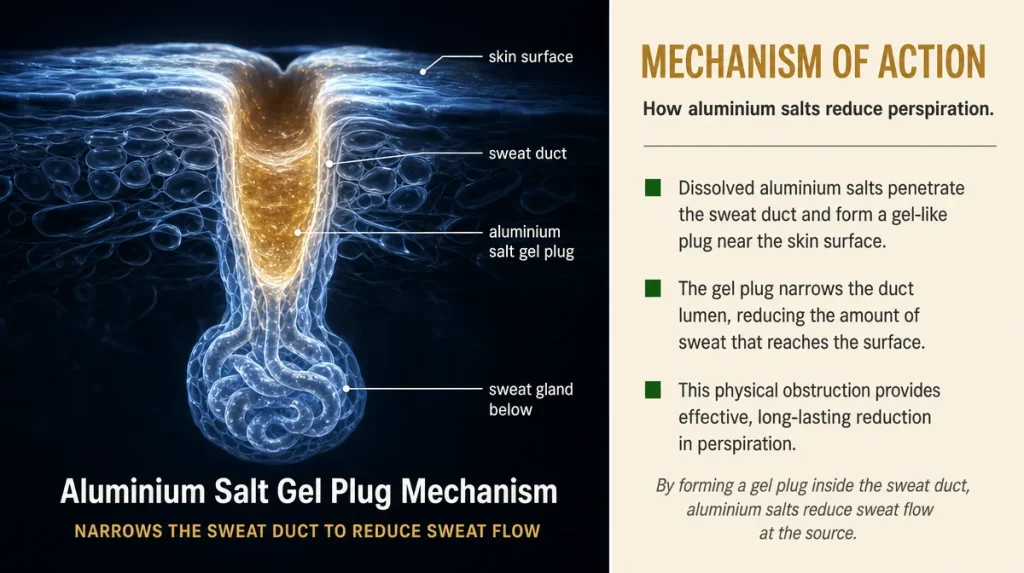
Think of a kitchen sink with the plug half in. Water still finds its way through the gaps, slower than before but never quite stopped. An antiperspirant’s active ingredient, usually an aluminium salt, works in something like the same way at the mouth of the sweat duct. It dissolves in the moisture already there and forms a temporary, gel-like plug that narrows the opening. Sweat production inside the gland carries on as normal. What changes is how much of it reaches the surface of the skin.
That plug is not permanent, and it is not meant to be. It washes away in the shower, breaks down with friction from clothing, and needs reapplying as it degrades. A product applied once at breakfast and expected to hold through a gym session, a stressful meeting and an evening out is being asked to do more than its chemistry allows.
A quick self-test: if an antiperspirant seems to fail reliably by the same time each day, note what happened in the hours before, a shower, a change of fabric, a particularly warm office. The pattern usually points to the plug being disturbed physically rather than the product being faulty.
Deodorant Or Antiperspirant: Knowing Which Job You Need Done
The two words get used almost interchangeably on the high street, which causes most of the confusion at the shelf. A deodorant masks or neutralises the odour that bacteria produce when they break down sweat. It does nothing to reduce the amount of moisture itself. An antiperspirant reduces the moisture reaching the surface, and most formulas sold in Britain also contain a fragrance element that does the deodorant’s job at the same time.
Someone whose complaint is purely odour, with no particular issue around visible wetness or marks on clothing, may do perfectly well with a deodorant alone and save the stronger formula for days that call for it. Someone dealing with visible wetness through shirts, especially under pressure or heat, needs the antiperspirant’s blocking action, not just the scent.
A simple way to tell which problem is yours: smell is a deodorant problem, dampness and marking is an antiperspirant problem. Many people have both on different days and keep one of each rather than a single all-purpose product.
Reading The Ingredients List Without The Marketing Noise
Packaging leans hard on words like “clinical strength” or “48-hour protection”, and those phrases are not regulated in any way that guarantees a specific percentage of active ingredient. What actually matters is the concentration of the aluminium compound itself, usually aluminium chloride or aluminium zirconium listed among the first few ingredients, and whether it is a standard-strength formula or one marketed for heavier perspiration.
Fragrance-free is a genuinely useful distinction from unscented. Fragrance-free means no added scent ingredients at all. Unscented can still contain masking fragrance designed to cancel out another smell, which matters for anyone with a fragrance sensitivity.
Which? has run comparative lab trials on antiperspirant performance in the past, scoring products on measured sweat reduction rather than marketing claims, and its general findings are a useful reminder that a higher price on a shelf in Boots or Superdrug does not reliably track with a stronger or more reliable effect. The active ingredient and its concentration do the work, not the packaging around it.
The Application Window That Makes Or Breaks It
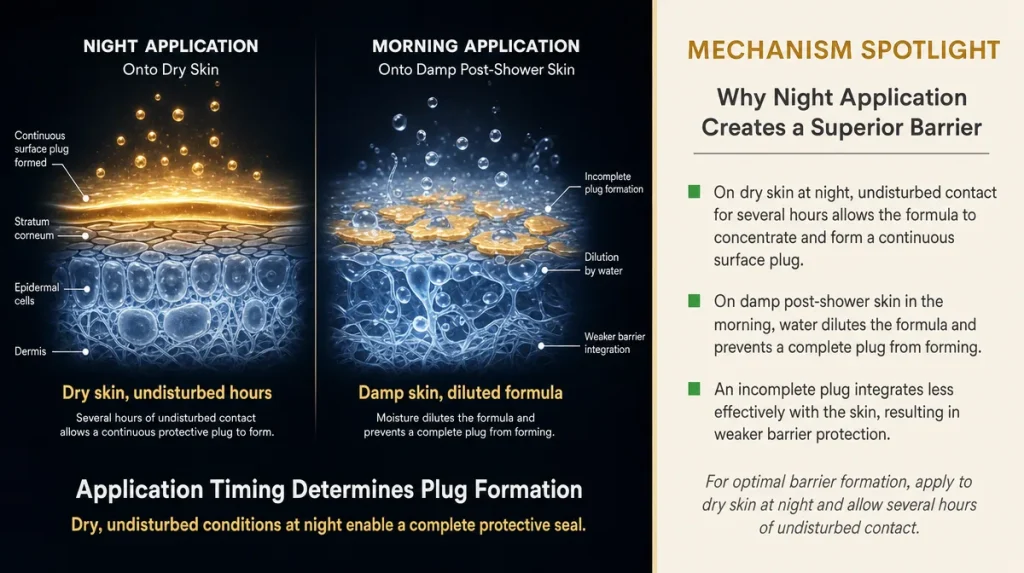
Night, not morning, is when an antiperspirant has the best chance of working as intended. Skin is drier and less active overnight, sweat glands are quieter, and the active salts have several undisturbed hours to form their plug properly before a morning shower or a day of movement and friction wash it away.
Applied straight after a hot shower, onto damp skin, the same product behaves differently. Water dilutes the formula and the salts cannot settle into the duct opening in the same concentrated way. A rushed application onto skin that is still slightly wet from towelling off is one of the most common reasons an otherwise decent product seems to underperform.
The practical routine that tends to work: apply at night to clean, fully dry skin, then a lighter top-up the next morning if needed, onto dry skin again. Two thin applications, correctly timed, generally outperform one heavy one rushed on at 7am.
Mistakes Everyone Makes, And Why They Undo The Effort
Shaving and applying straight afterwards is the single most common cause of stinging and irritation. Freshly shaved skin has microscopic nicks that an aluminium-based formula will find immediately. Leaving an hour, ideally applying at night after a morning shave, avoids most of this.
Layering antiperspirant over a body spray or a scented moisturiser is another frequent misstep. The fragrance ingredients in those products can interact with the active salts and reduce their effectiveness, and the combined scent often reads as muddled rather than more pleasant.
Overwashing the underarm area with a strongly exfoliating or medicated soap can also work against the product, stripping the natural barrier that helps skin tolerate the active ingredient. A gentle, unscented wash in that area is usually enough.
Lastly, switching formulas too often confuses the picture. Skin needs a week or two to settle with a new active ingredient before anyone can judge fairly whether it suits them.
Judging Results Honestly, And How Long To Wait
A fair trial of a new antiperspirant runs about two weeks of consistent, correctly timed application, not two days. Early irritation in the first few applications sometimes settles as skin adjusts, though irritation that worsens rather than improves is a sign to stop rather than push through.
Results worth looking for are a visible reduction in dampness on clothing by the end of a working day, and fewer marks appearing under stress or heat specifically, since no formula claims to stop sweat in genuinely hot conditions or intense exercise. A formula that performs well on an ordinary office day but is overwhelmed on a hot commute or at the gym is behaving normally, not failing.
Keeping a rough mental note, or even a note on the phone, of which product, which routine, and how the day went helps separate a genuinely weak formula from one that simply was not given a fair, consistent test.
Sensitive Skin, Irritation And When To Ask A Chemist
Redness, stinging or small bumps after applying an antiperspirant usually point to one of three things: a reaction to the aluminium compound itself, a reaction to added fragrance, or irritation from applying over broken or freshly shaved skin. The Good Housekeeping Institute’s general skincare guidance suggests patch testing any new product on the inner forearm for 48 hours before applying it to a more sensitive area, and that advice applies just as well here.
A fragrance-free, lower-strength formula is the sensible first swap for anyone reacting to a standard product. If irritation persists even with that change, a pharmacist behind the counter at a chemist can usually recommend an alternative formulation, and it is worth asking rather than guessing on a second purchase.
Persistent, heavy sweating that does not respond to any over-the-counter antiperspirant, particularly if it affects other areas of the body too, is worth raising with a GP. It may be a recognised condition with its own treatment path, and no amount of label-reading at the shelf will fix that on its own.
What Matters Versus What Is Marketing
Claims around “detoxing” the underarms or “letting the skin breathe” are marketing language rather than measurable mechanisms, and no published clinical evidence supports the idea that conventional antiperspirants need to be avoided for health reasons. Natural or mineral alternatives can work well for people whose main concern is odour rather than wetness, since many rely on antibacterial action rather than blocking ducts, but they are solving the deodorant problem, not the antiperspirant one, and are worth choosing with that distinction in mind rather than as a straightforward swap.
Scent strength and packaging design say nothing reliable about performance. The active ingredient, its concentration, and how consistently it is applied do the actual work. A modestly priced formula from a chemist shelf in Boots or Superdrug, used correctly at night on dry skin, will usually outperform an expensive one used carelessly on damp skin in a rush.
Key Takeaways
Antiperspirants reduce sweat reaching the skin’s surface, they do not stop glands working. Night-time application to clean, dry skin gives the active salts the best chance to work properly. Irritation after shaving, layered fragrance, or applying to damp skin are the three most common reasons a decent product seems to fail. Give any new formula a fair two-week trial before judging it, and speak to a chemist if irritation persists or to a GP if sweating is heavy and does not respond to anything over the counter.
A Quick Checklist Before Buying Again
- Decide whether the problem is odour, wetness, or both, and choose a deodorant or antiperspirant accordingly
- Check whether the label says fragrance-free rather than unscented, if sensitivity is a concern
- Plan to apply at night to dry skin, with a lighter top-up in the morning if needed
- Avoid applying straight after shaving or straight after a hot shower
- Patch test a new formula on the inner forearm for 48 hours first
- Give it two weeks of consistent use before deciding it does not work
- Ask the pharmacist at the chemist counter if irritation continues
This article is general information and does not replace individual medical advice.
Individual results vary, and anyone with persistent skin reactions or heavy sweating should speak to a pharmacist or GP.